Loading...
25%

Taxmann Indian Accounting Standards & Corporate Accounting Practices By T P Ghosh 10th Edition Nov 2025
₹7495M.R.P.: ₹9995
save ₹2500 (25%)
Free delivery on orders above ₹750
1
Free Delivery
On orders above ₹750
2 Days Return
Easy returns & refunds
Cash on Delivery
Pay when you receive
Secure Payment
100% secure transactions
Certified Product
Authentic & verified
Product Details
ISBN-13
9789371269148
Publisher
taxmann
Weight
4000 grams
Edition
10 TH EDITION
About the Book
Taxmann Ind AS & Corporate Accounting Practices By T P Ghosh 10th Edition Nov 2025
Taxmann Ind AS & Corporate Accounting Practices By T P Ghosh 10th Edition Nov 2025
Description
Indian Accounting Standards & Corporate Accounting Practices is widely regarded as India’s most authoritative, comprehensive, and practice-oriented commentary on the Ind AS framework. Spanning over 5,000 pages across three meticulously structured volumes, Prof. (Dr) T.P. Ghosh presents a definitive work that accomplishes four core objectives,
Offers deep conceptual interpretation of every Ind AS, explaining not just the rules but the underlying principles
Connects Ind AS with global IFRS developments, including IFRS 16, IFRS 17, IFRIC 22, IFRIC 23, and the upcoming IFRS 18 and IFRS 19 (effective 2027)
Integrates Indian regulatory requirements, particularly the Schedule III Division II and Division III reporting formats
Demonstrates reporting practices through:
Over 400 corporate disclosure extracts from Indian companies
More than 700 interpretative and numerical examples, including valuation models, EPS computations, impairment analyses, ECL mechanics, and hedge accounting illustrations
Numerous diagrams, decision trees, and flowcharts that simplify complex concepts
The coverage of the book is as follows:
Volume 1 — Presentation of Financial Statements | Foundational, Structural & Consolidation Standards
Part I – Transition to Ind AS
Covers first-time adoption under Ind AS 101, including exceptions, optional exemptions, reconciliations, transition balance sheet requirements and practical transition mechanics
Part II – Ind AS-based Financial Reporting Framework
Explains the integration of Ind AS 1 with Schedule III, detailed rules for current–non-current classification, and earnings per share under Ind AS 33—including complex capital structures
Part III – Standalone Financial Statements
Provides extensive guidance on preparing the Statement of Profit and Loss (including OCI presentation), Statement of Cash Flows (direct and indirect methods), material accounting policies, and a structured approach to drafting Notes to Accounts
Part IV – Consolidated Financial Statements
Covers control evaluation under Ind AS 110, classification of joint arrangements (joint operations vs joint ventures), the equity method under Ind AS 28, NCI measurement and full templates for consolidated reporting
Part V – Presentation Principles
Discusses Ind AS 8, 10, 24, 105, 108 and 114, along with complex illustrations on CODM identification, reclassifications, and discontinued operations
Volume 2 — Elements of Financial Statements | Recognition, Measurement & Disclosure Across All Major Ind AS Areas
Part VI – Measurement Principles
A comprehensive discussion of valuation techniques under Ind AS 113, updated foreign currency translation rules under Ind AS 21, share-based payment modelling (volatility, risk-free rates, dividend assumptions), and hyperinflation accounting under Ind AS 29
Part VII – Revenue (Ind AS 115)
Expands the five-step model with more than 50 examples, covering licensing, royalties, warranties, breakage, returns, repurchase agreements and other industry-specific issues.
Part VIII – Inventories, Expenses, Taxes & Provisions
Covers Ind AS 2, 12, 19, 23, and 37, including detailed actuarial valuation examples for employee benefits, complex scenarios on deferred tax (including Pillar Two rules), and full guidance on inventory costing, provisions and borrowing costs
Part IX – Assets, Depreciation & Impairment
Includes recognition and componentisation of PPE, decommissioning liabilities, comprehensive coverage of intangible assets (including cloud-computing configuration costs and cryptocurrencies), and in-depth CGU-level impairment modelling under Ind AS 36
Part X – Government Grants
Explains the distinction between grants and government assistance, accounting for forgivable loans, capital grants, interest subsidies and grant repayments
Part XI – Business Combinations
Covers the acquisition method, valuation of contingent consideration, accounting for replacement awards, and treatment of common control transactions using the pooling-of-interests method
Volume 3 — Financial Instruments | India’s Most Complete Ind AS Commentary on Financial Instruments
Part I – Presentation (Ind AS 32)
Clarifies the distinction between financial liabilities and equity, puttable instruments, compound instruments and treatment of treasury shares
Part II – Recognition, Classification & Measurement (Ind AS 109)
Explains business model assessment, SPPI testing with multiple examples, effective interest rate mechanics, and measurement under amortised cost, FVOCI and FVPL
Part III – Derivatives & Embedded Derivatives
Covers currency forwards, options, swaps, bifurcation of embedded derivatives, and distinctions between commodity and financial derivatives
Part IV – Reclassification
Discusses reclassification triggers and the accounting consequences across categories
Part V – Impairment (ECL Model)
Detailed analysis of 12-month vs lifetime ECL, SICR evaluation, macroeconomic overlays, forward-looking information and treatment of collateral
Part VI – Hedge Accounting
Explains fair value, cash flow and net investment hedges; effectiveness testing; and the treatment of time value, forward elements and basis spreads
Part VII – Derecognition
Covers pass-through arrangements, continuing involvement, and partial derecognition scenarios
Part VIII – Equity Swaps & Liability Extinguishment
Details IFRIC 19 mechanics with illustrative examples on settlement of financial liabilities using equity instruments
Part IX – Disclosures (Ind AS 107)
Provides extensive templates and illustrations for credit, liquidity and market risk disclosures; transfer and derecognition disclosures; offsetting; and sensitivity analyses
Every chapter across the three volumes follows a consistent and highly instructional architecture:
Conceptual Grounding – Introduces the principle, links to the conceptual framework and explains relevant IFRS parallels
Principle-based Exposition – Breaks down the wording, structure and intent of the standard, paragraph by paragraph
Interpretative Commentary – Offers expert analysis on judgment areas, alternative interpretations, and practical application issues
Numerical Examples & Valuation Tables – Includes DCF models, present value techniques, risk adjustments, option valuations, swap valuations and other computations
Illustrative Corporate Disclosures – Extracts and annotates Ind AS disclosures from Indian companies for practical insight
Common Pitfalls & Practice Issues – Highlights frequent errors, misinterpretations and practical complexities faced by preparers
Summary Tables, Checklists & Diagrams – Uses charts, flow-logics and structured tables to simplify complex standards and aid rapid learning
No reviews yet. Be the first to review!
Related Books

Taxmann GST Appeals & Appellate Tribunal By CMA Dipak N Joshi 1st Edition Dec 2025
by CMA DIPAK N JOSHI
₹1380₹1725

Commercial Income Tax Act 2025 by CA Girish Ahuja 1st Edition 2025 Commercial Income Tax Act 2025 by CA Girish Ahuja 1st Edition 2025
by Girish Ahuja & Ravi Gupta
₹1799₹2495

Book Corporation Compendium on GST By Vivek Jalan , S.K. Panda 1st Edition Dec 2025
by Vivek Jalan
₹5845₹7795
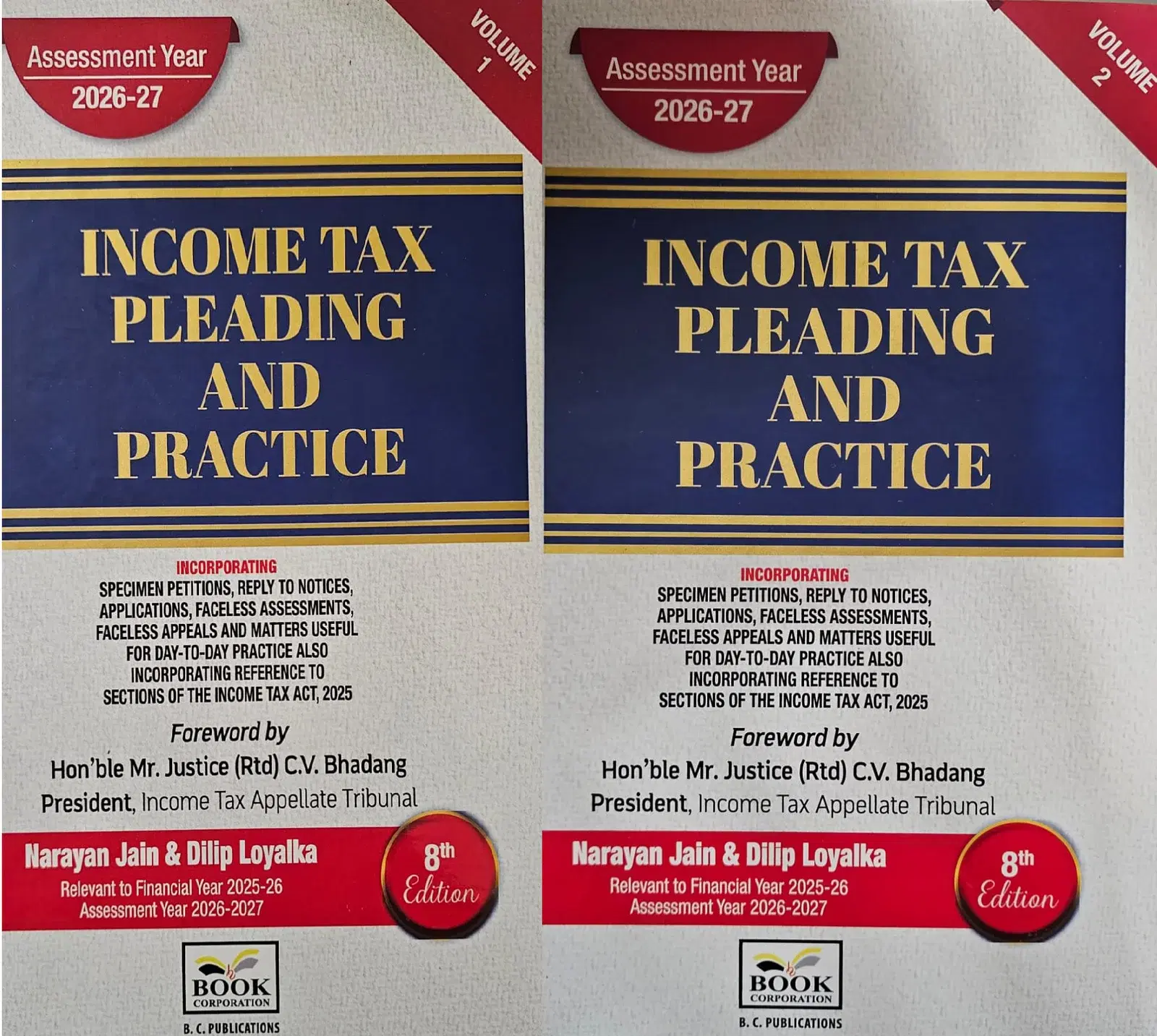
Book Corporation’s Income Tax Pleadings and Practice by Narayan Jain & Dilip Loyalka 8th Edition Dec 2025
by Narayan Jain
₹5245₹6995

Management Accounting By Dr Madhu Vij, Dr Deepika Dhingra 2nd Edition June 25
by Dr Deepika Dhingra
₹635₹795

Alternate Dispute Resolution Including Mediation Act 2023 by Gulzari Lal Sharma Raman Kumar Sharma 2nd Edition 24
by GULZARI LAL SHARMA RAMAN KUMAR SHARMA
₹395₹495
![LIMITED LIABILITY PARTNERSHIP with FAQs [University Edition] By J.P. Sharma 1st Edition 2019](/_next/image?url=https%3A%2F%2Fwww.makemydelivery.com%2Fwp-content%2Fuploads%2F2025%2F11%2FLIMITED-LIABILITY-PARTNERSHIP-with-FAQs-University-Edition-By-J.P.-Sharma-1st-Edition-2019.jpg&w=3840&q=75)
LIMITED LIABILITY PARTNERSHIP with FAQs [University Edition] By J.P. Sharma 1st Edition 2019
by J.P. Sharma
₹360₹450

BUSINESS LAWS By by J.P. Sharma & Sunaina Kanijia 1st Edition 2019
by J.P. SHARMA & SUNAINA KANOJIA
₹680₹850